What is a point spread and how does it differ from a moneyline bet.
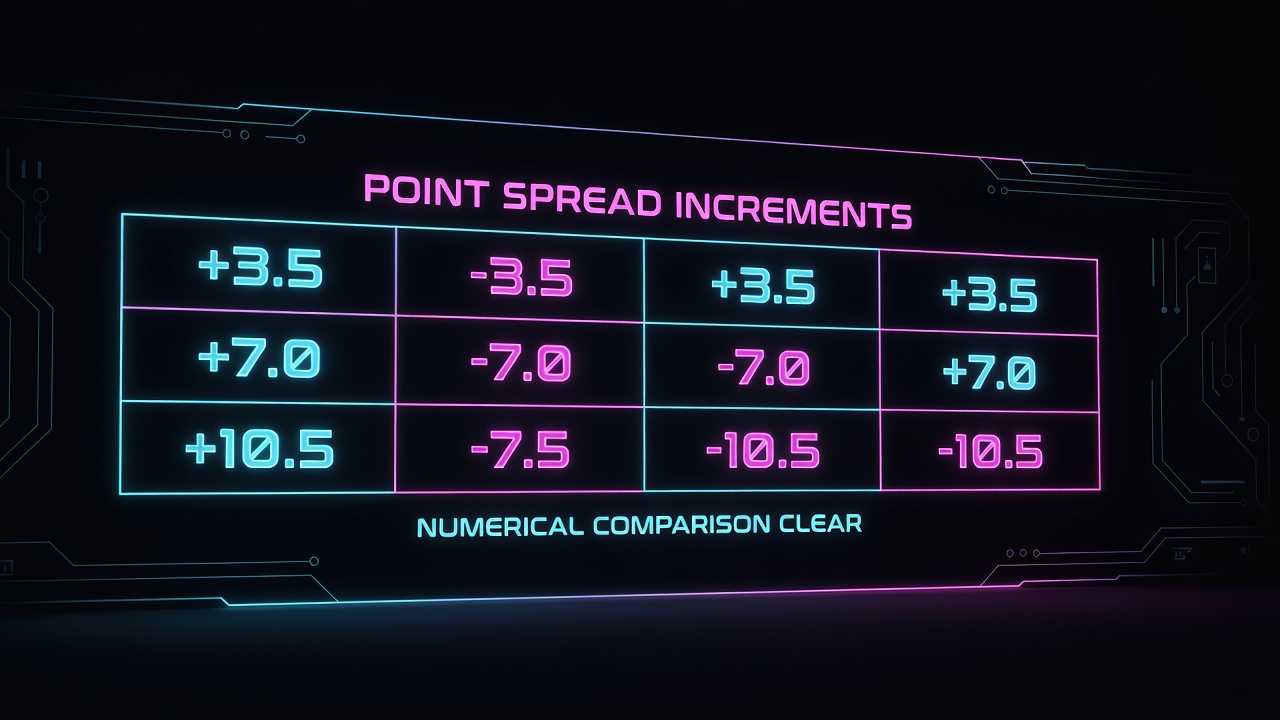
A moneyline bet is a simple win-or-lose bet on which team will win the game. A point spread bet involves a margin of victory. The favourite is given a negative point spread, meaning they must win by more than the spread. The underdog is given a positive spread, meaning they can lose by less than the spread or win.
For example, if the spread is minus-seven for the favorite, the favorite must win by eight or more points. If the spread is plus-seven for the underdog, the underdog can lose by six or fewer and the bet wins.
Q. Why do sportsbooks use point spreads.
A. Point spreads equalize the betting action. Without spreads, everyone would bet the favorite moneyline. Spreads encourage some bettors to take the underdog, which balances the book and allows the sportsbook to profit from the commission (the vig) rather than from correctly predicting outcomes.
Q. What is the vig and how much is it.
A. The vig is the commission the sportsbook takes on point spread bets. A typical bet is minus-110, meaning you must wager 110 dollars to win 100 dollars. The sportsbook's 10-dollar commission on a 110 dollar bet is approximately 9 percent. This is the vig.
Q. Can you beat point spreads through analysis.
A. Yes, but it is very difficult. A bettor must find discrepancies between the public consensus line and the true probability of the outcome. This requires data analysis, model building, and discipline. Most casual bettors cannot beat the vig and the closing line value simultaneously.
Q. What is closing line value and why does it matter.
A. Closing line value is whether you bet at better or worse odds than the final line. If you bet at minus-seven and the line closes at minus-six-point-five, you got plus-zero-point-five. Over many bets, bettors who consistently get plus closing line value profit. Those who consistently get minus closing line value lose.
Q. Should a beginner bet point spreads or moneylines.
A. Either is fine, but understand that point spreads require you to beat a 9 percent vig before you break even. Moneylines typically have a smaller vig but require correct binary selection. Both are difficult to beat.
Additional Analysis and Considerations
The mechanisms described above represent only the surface-level understanding of this topic. Deeper examination reveals several sophisticated variations and edge cases that merit thorough exploration. Professional participants in this space have developed careful strategies over years of experience and observation.
When evaluating the practical applications, consider that historical precedent provides valuable guidance. Market dynamics have shifted substantially over the past decade, and contemporary approaches must account for modern regulatory frameworks and technological innovations that were unavailable previously.
The interplay between theoretical models and real-world execution creates a persistent gap. Participants who understand both dimensions maintain consistent advantages over those who focus exclusively on one or the other. This duality shapes outcomes more substantially than any individual factor.
Implementation Best Practices
Successful practitioners report that disciplined adherence to fundamental principles yields superior results across extended time horizons. While short-term variance inevitably creates periods of apparent contradiction, the underlying mathematical relationships remain stable.
The specific techniques employed vary based on individual circumstances, bankroll constraints, and risk tolerance profiles. What functions optimally for one participant may prove suboptimal for another despite identical initial conditions. The customization layer cannot be overlooked when evaluating competitive success.
Experienced observers note that emotional discipline surpasses intellectual understanding in determining long-term outcomes. A participant with thorough comprehension but inadequate emotional control typically underperforms a less technically sophisticated competitor with superior psychological stability.
Conclusion
The landscape continues evolving as new information emerges and market participants adjust their approaches. Those who maintain intellectual curiosity and willingness to challenge established assumptions position themselves advantageously for sustained success in this complex domain.