
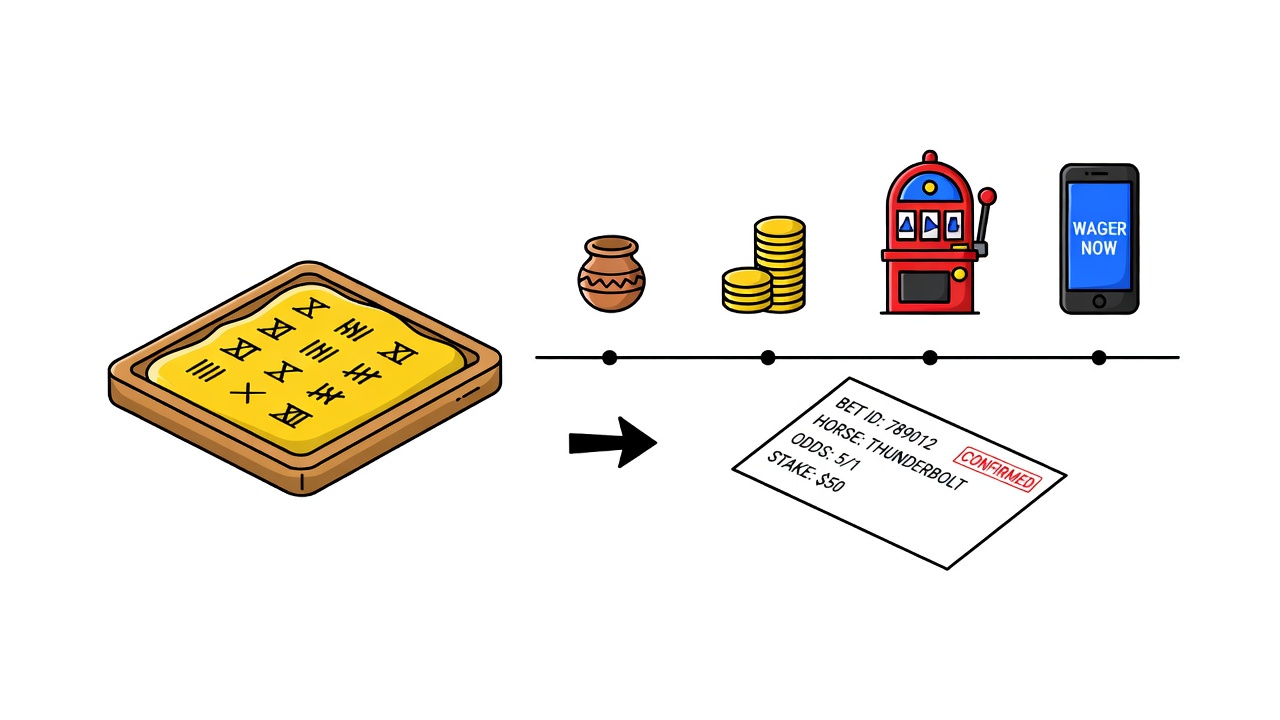
The Roman Senate banned gambling repeatedly. Cicero complained about it in his speeches. Emperors legislated against it. And yet, every amphitheater, every bathhouse, every tavern in Ostia reeked of small fortunes changing hands on the gladiatorial games. The patrician who emerged from the catacombs at dusk having placed a month's allowance on a charioteer wasn't breaking an obscure law; he was performing one of antiquity's most durable traditions. Betting on athletic competition is older than the republic itself.
The Roman bookmaker, if we can call him that, operated with the kind of informal blessing that existed before anyone thought to legalize or regulate anything. A man with ready capital would position himself at the games, accept wagers, and keep an accounting system that relied entirely on memory and his reputation. These were not mere loan sharks. The best ones became trusted figures. They extended credit. They knew the form of every chariot team. They had sources. The resemblance to a modern sportsbook is eerie.
The Medieval Interlude
Christian Europe didn't kill betting on sports; it just made it morally complicated. The Church condemned gambling as the province of sin and idleness. Rulers banned it periodically. And yet nobles wagered on tournaments, merchants on horse races, peasants on cock-fighting. The form changed. The spirit didn't.
By the fourteenth century, Italian city-states had begun to formalize the practice. Venice, Florence, and Milan recognized that controlling gambling revenue was more profitable than banning it. Tax the bookmakers instead of prosecuting them. Regulate the odds instead of outlawing them. This is where the modern concept began to emerge: gambling as a licensed industry, managed by the state, taxable and transparent.
The transition from informal wagering to bookmaking as a profession happened during the horse-racing boom in Britain. By the sixteen hundreds, horse racing was the sport of kings and the obsession of everyone else. A man named John Massey is credited as one of the first formal bookmakers, taking wagers at Newmarket in the seventeen hundreds. He didn't invent the practice. He just gave it structure.
What Massey and the early professional bookmakers provided was crucial: a counterparty who would always accept bets. You didn't need to find another gambler and haggle terms. You found a bookmaker, he offered you odds, and the transaction happened.
The bookmaker absorbed the risk himself. That's the innovation that separated bookmaking from simple wagering.
The Odds Question
The early bookmakers used what's now called overround. They'd offer odds that guaranteed them a profit regardless of the outcome. A horse race with two horses might have true odds of even money on each side. But the bookmaker would offer five-to-four on both, guaranteeing himself a margin. Punters understood this. They were paying for convenience, not charity.
This mechanism created a problem that still exists today: sharp bettors would attack soft books. A group of sophisticated handicappers in the seventeen hundreds would identify bookmakers whose odds were badly set and hammer them. The bookmaker would go bankrupt or adjust his odds rapidly. This pressure forced professional bookmakers to develop better information networks and sharper analytical methods. The arms race between bookmakers and sophisticated bettors created an industry that had to think harder about why horses won.
The American Period
American bookmakers emerged in the eighteen hundreds with less regulation and more chaos. Pool selling and handbook operations worked in the shadows of legality. The bookmakers who thrived were the ones with connections to local politicians and police. Corruption was explicit. You paid for protection and the right to operate.
The Professional Gambler magazine began publishing in 1881. Betting guides and tip sheets became industries. By the nineteen hundred, American cities had hundreds of illicit betting shops. The biggest operators like Tim Murnane became celebrities. They were athletes of the gambling world, known for their nerve and their sophistication.
Prohibition didn't kill bookmaking. It moved it underground and made it more violent. The La Cosa Nostra and other criminal organizations controlled much of the betting market in the mid-twentieth century. Bookmakers worked in backrooms. They still provided the essential service: guaranteed odds on demand.
The Legitimacy Shift
Modern legalized sportsbooks began in Nevada in 1949, after decades of technically illegal but widely tolerated gambling. The state decided that regulating and taxing the industry was more sophisticated than pretending it didn't exist. Legal sportsbooks became casinos' cousins. They operated by rules. They were inspected. They paid taxes.
The digital revolution moved sportsbooks online in the late nineteen nineties. The basic mechanics remained identical to the ancient Roman model: the operator accepts wagers, offers odds, and profits from the spread. The distribution changed. The math didn't.
What's remarkable about bookmaking history is how little the core function has changed in two thousand years. The Romans used messengers and memory. We use algorithms and databases. The Roman bettor wanted action on the chariot race. The modern bettor wants action on the football game. The bookmaker's job is still the same: set odds that are appealing to both sides, manage the imbalance, and pocket the vig.