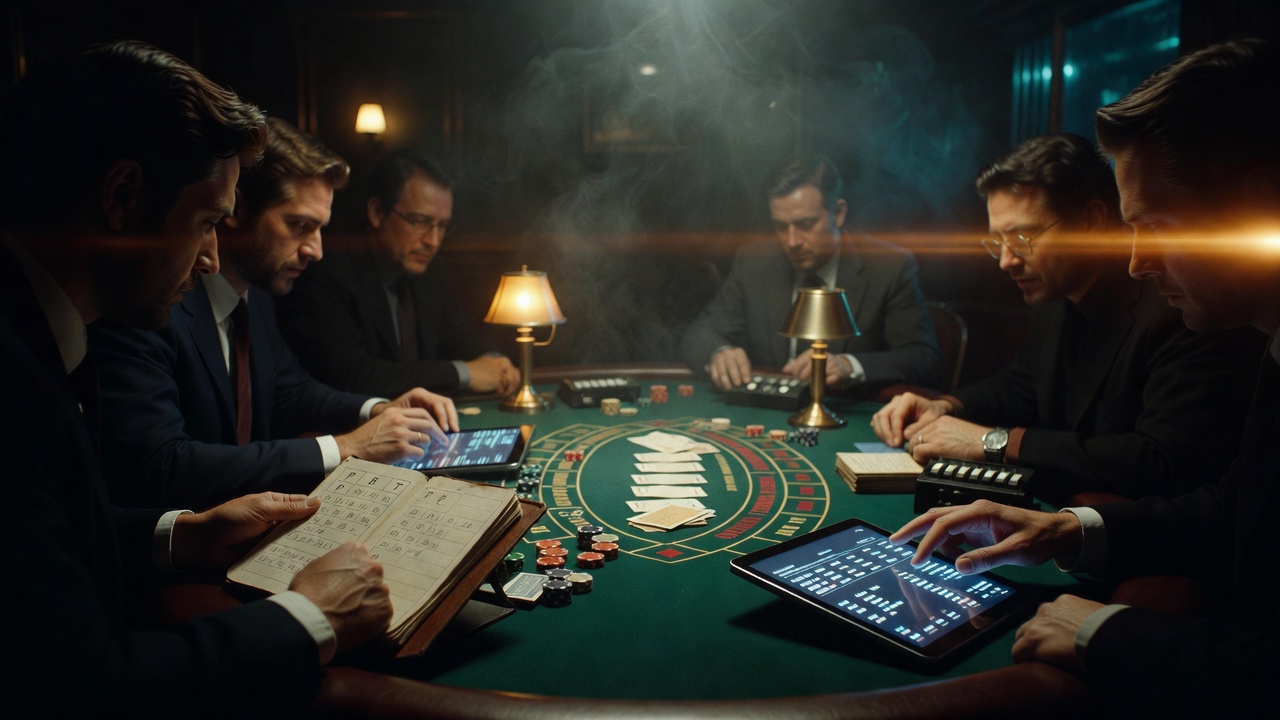
March 14th, 2019. The Golden Dragon Casino in Manila. A woman named Chen had been sitting at the baccarat table for eleven hours. In front of her, seven sheets of paper filled with tiny marks: Bs and Ps in columns, slash marks crossing them out, circles around certain rows. This was a baccarat roadmap. A record of every hand. A pattern that did not exist but that she believed in absolutely.
Baccarat is the simplest game in the casino. Bet on the Bank, bet on the Player, or bet on a Tie. The dealer runs through shoes of eight decks. Each hand takes ninety seconds. The game has no decisions. No strategy. The only variable is which side wins more often, and by how much. The house edge on Bank is 1.06 percent. The house edge on Player is 1.24 percent. The Tie is a trap, paying 8 to 1 on a hand that occurs 50 times per thousand. The mathematical expectation is identical every hand.
Yet baccarat players track every result on a roadmap.
A roadmap is a visual record of which side won, organized into columns of six. When a Bank hand wins, a player marks B. When Player wins, a mark P. The columns fill downward. When a new shoe starts, a new column begins. Some players add extra columns called "alternate roads" or "derived roads," which are mathematical transformations of the original sequence. The derived road is supposed to reveal patterns that the raw data hides. It doesn't. But the belief persists that if you track results long enough, you'll spot a shift in the shoe before it happens.
Chen was playing a high-stakes game. The minimum bet was two hundred dollars. She had lost forty thousand dollars by 3 p.m. By 8 p.m., she had lost ninety thousand. The casino floor manager watched her because he knew what he was seeing: a woman trying to find order in randomness. A woman who believed that seven sheets of marks would reveal the future.
Baccarat roadmaps exist because of a cognitive bias called the gambler's fallacy: the belief that past results predict future outcomes in games of pure chance. After six Player hands in a row, players feel that a Bank hand is "due." The roadmap provides visual evidence for this feeling. A long streak of Ps followed by a B confirms the pattern. What it actually is: regression to the mean. Long streaks in random data are normal. The appearance of a pattern after a streak is also normal. The roadmap makes random noise look like a signal.
The Derivation
Some players build more complex roadmaps. The main road tracks raw results. The bead plate is a visual arrangement of colored beads that represent the same data. The big road and small road are derived from the main road using specific rules. The small road supposedly shows patterns that the big road misses by using a compression algorithm. None of these reveal anything that random variation wouldn't produce. Yet players spend money on roadmap apps, tutorial videos, and strategy guides that teach complex derivation rules.
At 10 p.m., Chen left the table. She was down one hundred and thirty thousand dollars. She had twenty-two pages of roadmaps, each one filled with marks that proved nothing except that she kept looking.
The mathematics is against baccarat roadmaps for one reason: baccarat shoes are not truly random. They're shuffled. Mechanical shufflers in casinos are imperfect. Shoe penetration (how deep the dealer cuts before reshuffling) creates slight biases. Some shoes run Bank-heavy. Some run Player-heavy. But the bias is so small (usually 0.3 to 0.8 percent in one direction) that you'd need several thousand hands to detect it. By the time you've played that many hands, you've lost enough to money to neutralize any edge you gained from knowing which side was slightly favored.
Elite baccarat players do exist. They count cards in a mathematical sense, tracking which denominations have been dealt to estimate the composition of the remaining shoe. This requires memory and math. The players that use roadmaps are not elite. They are trying to shortcut expertise by believing that sheets of marks will do the mathematical work for them.
Why The Casinos Let Players Keep Doing It
Casinos don't ban roadmap tracking because it doesn't work. If roadmaps actually revealed patterns, casinos would have done the math and fixed the problem. Instead, casinos provide roadmap templates and beads and displays that show the results in roadmap format. They encourage the behavior because it makes players feel like they're doing something. Feeling like you're doing something is more addictive than admitting you're just guessing.
Chen came back the next night. She was down one hundred and forty thousand. She played for nine hours. The roadmaps in her notebook were filled again. She told the floor manager that the small road showed a Player run developing. She bet Player for three hands and lost all three. She lost another seventy thousand. On the fourth day, she stopped coming.
A baccarat roadmap is not a system. It's a visual representation of the belief that systems exist where none do. The casino profits from selling that belief to players who want the game to be more complex than it is. Complexity implies mastery. Mastery implies skill. Skill implies an edge. None of that is true in baccarat. The roadmap just makes the delusion easier to carry.