
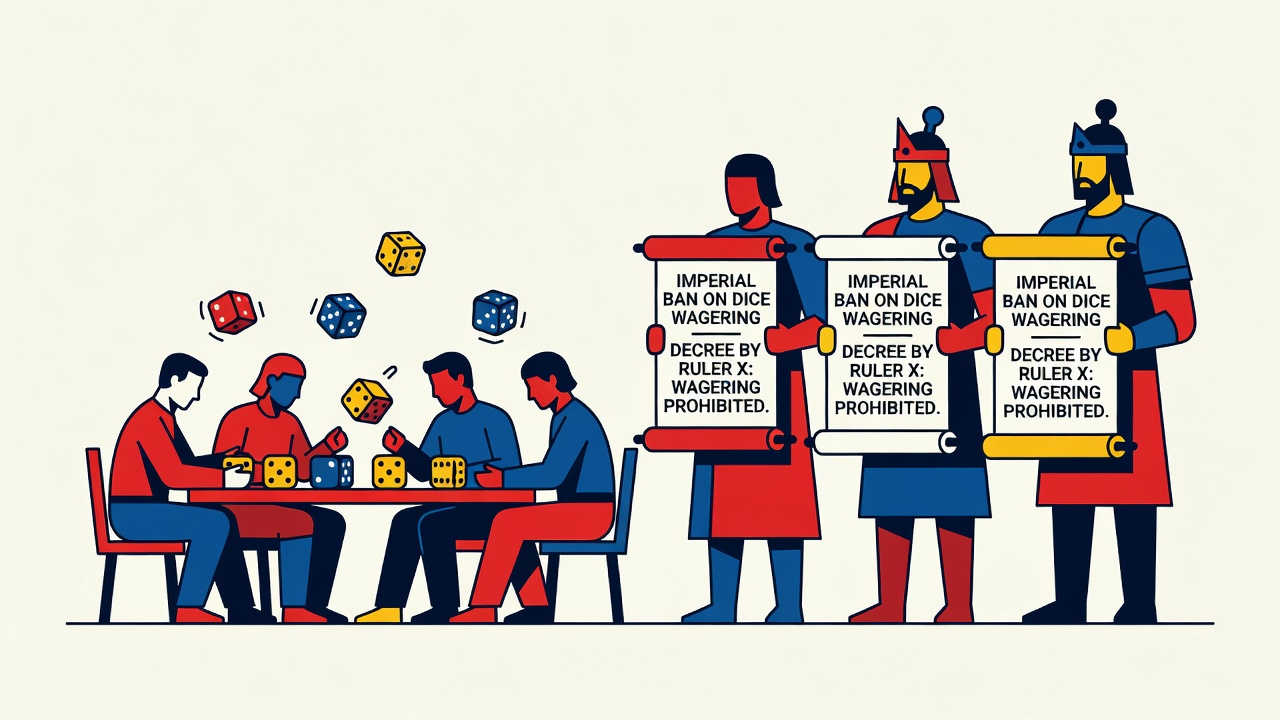
The legalized sports betting market in the United States generates roughly fifty billion dollars annually. Rome's gambling markets, adjusted for population and purchasing power, likely operated at similar scale relative to the economy. The historical record shows prohibition repeatedly failed, suggesting that gambling's economic gravity overwhelms regulatory intent.
Alea, or dice gambling, was technically illegal under Roman law in most periods. Augustus banned it for the general public, though exceptions existed for religious festivals. Claudius legalized it. Nero banned it again. The legislative swing tells you something important: the incentive structure doesn't change when you change the law. People want to gamble. The question is whether the state controls the revenue or loses it to the underground market.
The Mechanics of Roman Gambling
Roman dice, called tali, were carved from knucklebones. Later versions used cubic dice with faces numbered one through six. The game was mathematically straightforward: throw dice, get a number, win or lose based on predetermined outcomes. Three sixes was a winning roll, called the Venus throw. A winning combination was called the Royal.
The true odds can be calculated using basic probability. Rolling three sixes from three dice has a probability of one in two hundred sixteen. A player betting on that would need odds of around two hundred to one to break even long-term. The historical record suggests odds were typically less favorable, meaning the game favored the house.
Roman tabernae, which were tavern-gambling establishments, operated under informal licensing in some cities. The proprietor would maintain a house bank, take bets, and pay winners. These operators developed the same advantage-extraction techniques that modern sportsbooks use: they balanced action on both sides and extracted a margin.
The Economics of Imperial Bans
During periods when gambling was officially banned, the same establishments operated in a gray market. Enforcement was selective. The emperor would crack down periodically to make a moral statement, then enforcement would relax. This pattern is identical to alcohol prohibition in the United States from nineteen twenty to nineteen thirty-three.
Here's the model: prohibition increases the illegal market premium. If dice games are legal, the house edge on organized games might be three to five percent. If gambling is banned, street operators can demand ten to fifteen percent margins because players can't take their money to a regulated operator. The emperor's ban actually enriches the underground market and extracts zero tax revenue.
The most sophisticated analysis comes from Jerome Carcopino's Daily Life in Ancient Rome, which documents that wealthy Romans essentially ignored the gambling prohibitions. Senators gambled openly. Military officers gambled in their quarters. The law applied selectively to the lower classes, enforced when a particular emperor felt moralistic.
Why The Bans Failed
Rome had a significant sports betting culture around chariot racing and gladiatorial combat. Betting markets operated publicly at the venues. The games at the Circus Maximus drew hundreds of thousands of spectators, many of whom had money wagered on outcomes. The infrastructure of betting was built into the social and physical fabric of the city.
Prohibiting this wasn't like prohibiting a single crime; it required policing a normal social behavior. Augustus banned private dice games but couldn't eliminate them any more than you can eliminate poker games by making them illegal. People want the action. The regulatory authority can only choose whether the action happens transparently or in backrooms.
Later emperors understood this economic principle. Nero, despite his reputation, operated a more pragmatic gambling policy than Augustus.
He legalized gambling in certain contexts because he recognized that the state tax revenue from legal operations exceeded the enforcement costs of prohibition.
The Present-Day Pattern
Modern regulatory frameworks have applied this historical lesson. Legalized gambling generates tax revenue, creates employment, and ensures consumer protection. Nevada's model, which allows regulated sportsbooks, generates hundreds of millions in state revenue. That revenue can't be captured from prohibition.
The pattern is consistent across two thousand years: the emperor or state legislator proposes moral prohibition, enforcement proves expensive, voluntary compliance remains low, the state eventually legalizes and taxes, revenue flows to the treasury. The time lag between prohibition and legalization is just the period during which the state accepts lower revenue in exchange for the moral signaling of the ban.
Rome's gambling history offers an interesting data point on the Kelly Criterion and bankroll management concepts that professional bettors use today. The documented accounts of significant bettors show that the ones who survived the long term were the ones who managed their stakes carefully. They didn't bet everything on a single outcome. The ones who lost everything quickly were the ones who chased losses or over-committed on individual bets.
The fundamental truth that applied two thousand years ago still applies: the long-term edge belongs to careful analysis and disciplined staking. Emotional betting or poorly managed bankrolls loses to math regardless of era or jurisdiction. Rome's prohibition era didn't change that. Legalization didn't change it either. The numbers work the same way they always have.