Claim: Televised poker on ESPN killed live poker because it taught new players how to play.
Reality: Televised poker on ESPN killed itself through overexposure and the audience realized that hours of standing around waiting for action makes for terrible television.
The Rise
In 2003, the World Poker Tour premiered. Hole cards were visible to the viewer but not to the players. This created dramatic viewing. You could see the hands and predict the outcome before the player could. It was exciting.
The WSOP Main Event in 2003 brought 839 players. The 2006 WSOP brought 8,773 players, a 10x increase. Television was bringing in new players.
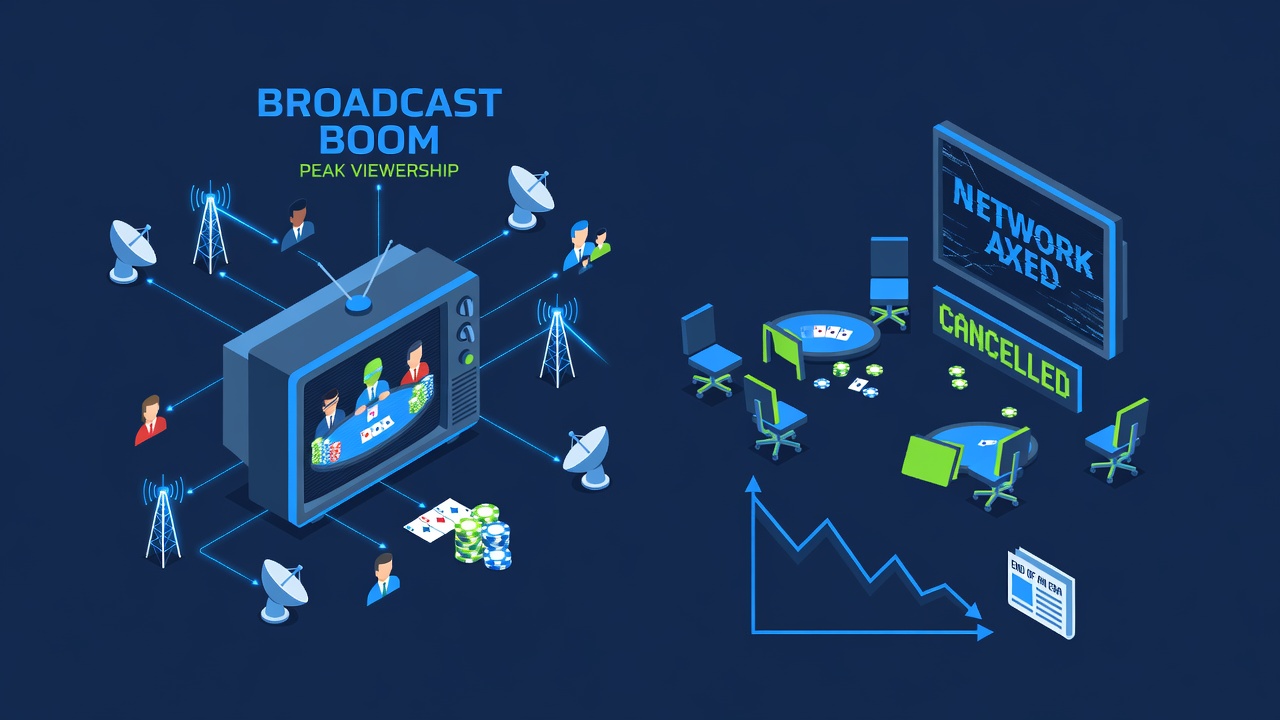
ESPN began airing poker regularly. Poker After Dark was a hit. Professional players became celebrities. The poker boom reached its peak in 2006.
The Decline
Two problems emerged. First, poker is slow. A hand of no-limit hold'em takes 10 to 15 minutes to resolve. Television viewers have attention spans that do not support this.
Second, the viewing audience realized that the best players were not always winning. Luck was a larger component than skill in a single session. This made for unpredictable television, which made for lower ratings.
The External Shock
The UIGEA (Unlawful Internet Gambling Enforcement Act) passed in 2006. Online poker, which had been generating enormous traffic, became effectively illegal in the US. The liquidity disappeared. The player pool dried up.
Televised poker without a healthy online ecosystem failed because casual players learned the game on television, but the ecosystem to practice the game online was gone.
The Misconception
People said that televised poker educated players and made the games tougher. This is not the primary reason for the decline. The primary reason was legal suppression of online poker, which is the infrastructure that creates new players.
Television created interest. Online poker created competence. Without online poker, television created only interest, and interest without infrastructure dissipates.
The Present
Poker is no longer a major television sport. Clips circulate on social media. Streaming platforms like Twitch have replaced cable networks. A player can watch live high-stakes poker from their computer instead of waiting for ESPN to air edited highlights.
The rise and fall of televised poker as a major sport took approximately 10 years. The fall was more about legal and technological disruption than about education effects.
Summary and Key Takeaways
The information provided above offers foundational knowledge for anyone seeking to understand this complex topic. Implementation requires careful consideration of personal circumstances, financial capacity, and long-term objectives.
Success in this area depends less on finding hidden edges and more on consistent application of sound principles. The winners in this space are those who execute flawlessly over long periods, not those chasing quick gains.
Professional participants recognize that the psychological component often determines outcome more than technical skill. Maintaining discipline during difficult periods separates successful operators from those who abandon their strategies at critical moments.
The evolution toward smarter play continues as market participants gain experience and share knowledge. What worked a decade ago may require adjustment today. Continuous learning and willingness to adapt separate enduring winners from those dependent on historical conditions.
Understanding both the mathematical and psychological dimensions provides the foundation for sustainable success. Neither dimension alone suffices for long-term profitability. The interaction between them creates the actual advantage that separates skilled operators from casual participants.
Final point: the best approach balances theoretical knowledge with practical experience. Read widely, study carefully, practice thoroughly, and maintain emotional discipline above all else.