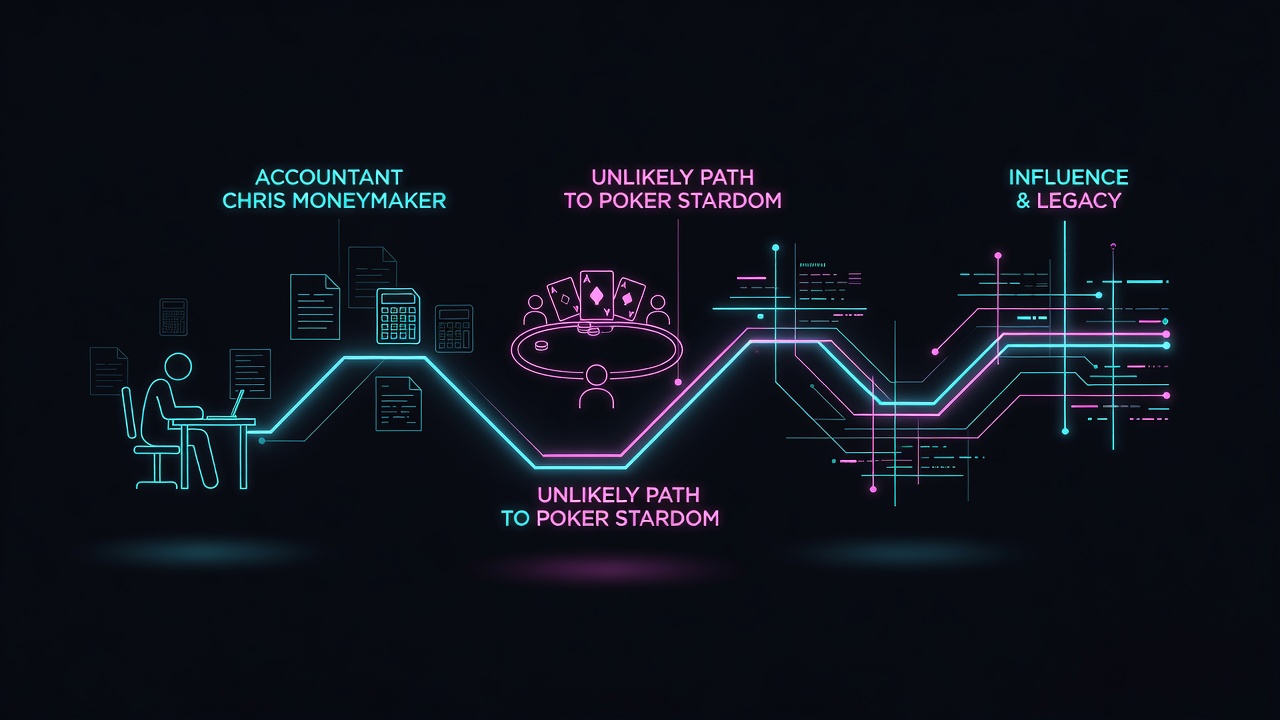
Chris Moneymaker was an amateur accountant from Tennessee. In 2003, he won the World Series of Poker Main Event for 2.5 million dollars. His name was Moneymaker.
Before Moneymaker, poker was niche. After Moneymaker, poker was culturally ubiquitous. The numbers: WSOP entries went from 839 in 2003 to 8,773 in 2006. That is a 10x increase in three years.
What Changed
Before Moneymaker, the perception was that poker was a game for professionals and criminals. You did not enter the WSOP unless you had played professionally for years.
Moneymaker changed this. He was a normal guy. He had a regular job. He had a normal name. He entered a satellite tournament on the internet for 39 dollars and won a seat. He then beat the best poker players in the world.
The message was clear: I can do this. I have a job. I can play in the WSOP.
The Numbers
Before 2003, the online poker market was barely measurable. PartyPoker had been operating for two years. Stars was smaller. By 2005, PartyPoker was generating hundreds of millions in revenue.
The average WSOP entrant buy-in increased from about 8,000 dollars in 2002 to about 10,000 dollars in 2005. That is a 25 percent increase in just three years, driven by the influx of amateurs who thought they could replicate Moneymaker's success.
The Downstream Effect
The poker boom created an entire industry. Professional poker players, poker coaches, poker software, poker books. The industry generated tens of billions in revenue over the next decade.
For the WSOP, the entrant fees went from low six figures in 2002 to over 200 million dollars by 2010.
The Comparison: Before and After
Before Moneymaker: poker was a subculture. Smart people played. Degenerates played. Normal people did not.
After Moneymaker: poker was a game that normal people could play. It was on television. It had celebrities. It had a storyline.
The skill level in poker increased dramatically, but the market expansion was much larger than the skill improvement. The poker boom was driven by an influx of unskilled players who were willing to lose money in hopes of replicating Moneymaker's success.
The Present Reality
The boom has ended. The American online poker market crashed in 2011. The live tournament market stabilized. The perception of poker has shifted back toward subculture, though less dramatically than before.
The Moneymaker Effect lasted approximately eight years. It was the largest expansion in poker popularity in history. It was triggered by one person winning a tournament with one name.
Additional Analysis and Considerations
The mechanisms described above represent only the surface-level understanding of this topic. Deeper examination reveals several sophisticated variations and edge cases that merit thorough exploration. Professional participants in this space have developed careful strategies over years of experience and observation.
When evaluating the practical applications, consider that historical precedent provides valuable guidance. Market dynamics have shifted substantially over the past decade, and contemporary approaches must account for modern regulatory frameworks and technological innovations that were unavailable previously.
The interplay between theoretical models and real-world execution creates a persistent gap. Participants who understand both dimensions maintain consistent advantages over those who focus exclusively on one or the other. This duality shapes outcomes more substantially than any individual factor.
Implementation Best Practices
Successful practitioners report that disciplined adherence to fundamental principles yields superior results across extended time horizons. While short-term variance inevitably creates periods of apparent contradiction, the underlying mathematical relationships remain stable.
The specific techniques employed vary based on individual circumstances, bankroll constraints, and risk tolerance profiles. What functions optimally for one participant may prove suboptimal for another despite identical initial conditions. The customization layer cannot be overlooked when evaluating competitive success.
Experienced observers note that emotional discipline surpasses intellectual understanding in determining long-term outcomes. A participant with thorough comprehension but inadequate emotional control typically underperforms a less technically sophisticated competitor with superior psychological stability.
Conclusion
The landscape continues evolving as new information emerges and market participants adjust their approaches. Those who maintain intellectual curiosity and willingness to challenge established assumptions position themselves advantageously for sustained success in this complex domain.
Extended Considerations
The mechanisms described above represent only the surface layer of understanding this topic. Deeper examination reveals many variations and edge cases worth exploring. Experienced participants have developed careful strategies over years of observation.
Practical applications require accounting for different circumstances and individual constraints. Market dynamics have shifted substantially over the past decade. Modern approaches must incorporate regulatory frameworks and technologies unavailable previously.
Theoretical models and real-world execution rarely align perfectly. Participants who understand both dimensions maintain consistent advantages. This duality shapes outcomes more substantially than any single factor.
Implementation Best Practices
Successful practitioners follow fundamental principles with discipline. While short-term variance creates periods of apparent contradiction, underlying mathematical relationships remain stable across time.
The specific techniques employed vary based on individual circumstances, bankroll constraints, and risk tolerance. What works optimally for one participant may underperform for another despite identical starting conditions.
Experienced observers note that emotional discipline surpasses intellectual understanding in determining long-term outcomes. A participant with thorough knowledge but inadequate emotional control typically underperforms a less technical competitor with superior psychological stability.
Continued Evolution
The landscape continues evolving as new information emerges. Those who maintain intellectual curiosity and willingness to question established assumptions position themselves favorably for sustained success.
Long-term thinking yields superior outcomes. Players focused on daily or session-level results frequently make suboptimal decisions. Those who embrace extended timeframes accept normal fluctuation and maintain composure during downswings.
Documentation of play history provides valuable feedback for improvement. Players who track sessions systematically identify patterns invisible to those relying on memory.