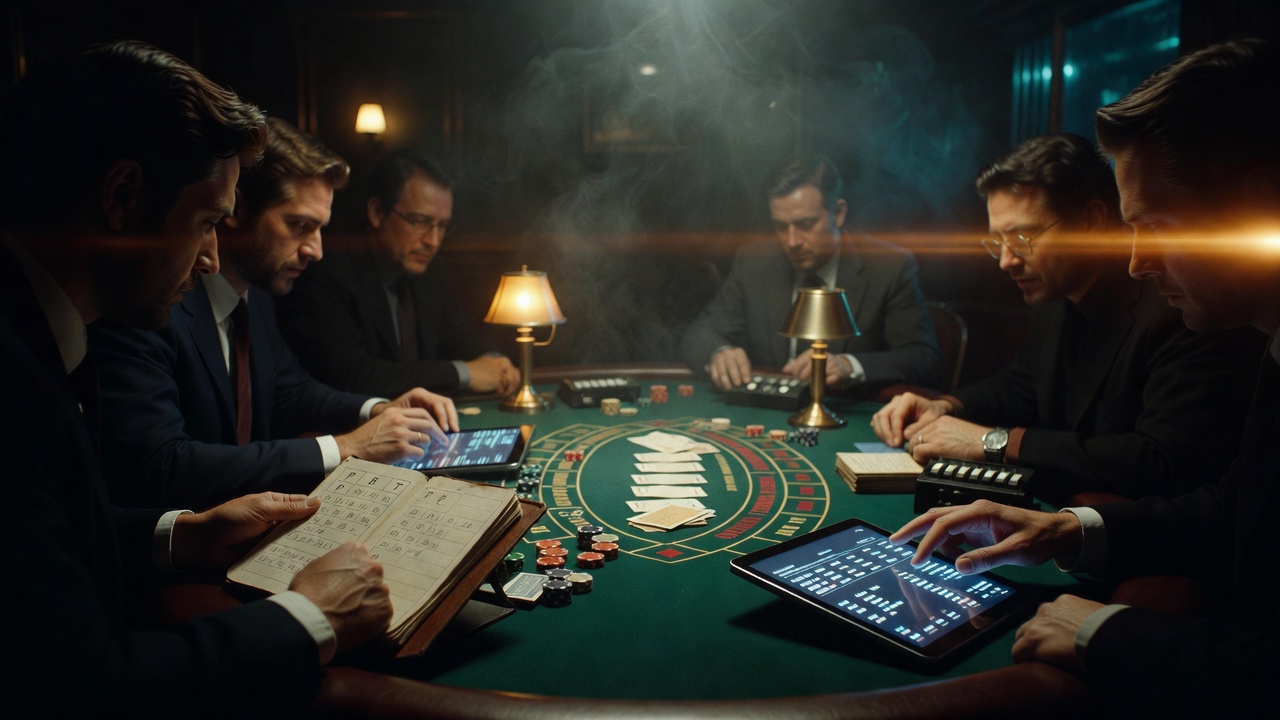
What is the relationship between seeing and knowing? The ancient observer asked this question while examining physical objects. The modern observer asks it while watching a live baccarat table from eight different angles simultaneously. Does increasing the number of ways we observe an object change our knowledge of it, or does it merely multiply our illusion of understanding?
Live baccarat uses multiple camera angles. The player can switch between views: the dealer's perspective, the table surface view, a close-up of the shoe, a wide shot of the studio, a view of the cards as they're dealt, a view of the outcome board. Some studios offer ten or twelve distinct angles. The experience is immersive. The player feels they're controlling a cinematic experience. One might ask: does this add information, or does it add distraction?
Consider the nature of baccarat itself. Two hands are dealt. One gets closer to nine. That hand wins. The mathematical outcome is determined the moment the shoe composition is set. The cards that will be dealt are already decided. The camera angles do not change this. They cannot reveal information that doesn't exist. Yet the multiplicity of cameras creates the sensation that some angle might contain the answer the other angles missed.
The Mechanics of Multi-Camera Production
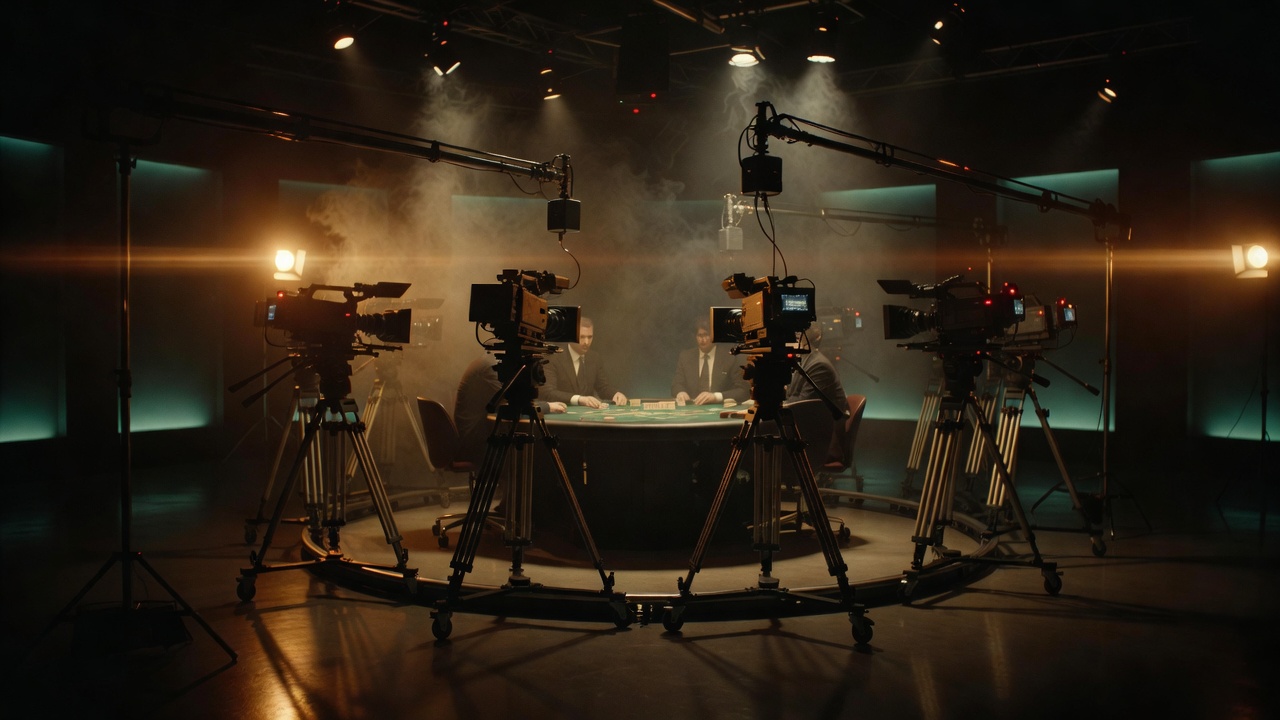
A typical live baccarat studio runs six to eight permanent cameras. Some angle downward at forty-five degrees, capturing the dealer's position and the cards face-up on the table. Others run wide-angle at table level, showing the layout from the player's seated perspective. One camera films the shoe mechanism at close range. Another captures the cut card and the burn. Audio is captured separately. All feeds are sent to a switching system that allows the player in real time to change views. The switching delay is negligible: ten to twenty milliseconds. The player perceives instantaneous control.
The psychological effect of camera control is significant. The player is not merely observing; they are directing. They are choosing which angle contains the truth they seek. This creates an illusion of agency. In reality, they are choosing which distraction to witness. But the illusion of control over the observation feels like control over the outcome.
Some studios have added features that enhance this illusion further. Slow-motion replays. Zoomed cards from multiple angles. Statistics about which position won more often (always roughly equal, but the visual presentation suggests patterns). These features do not provide information that would improve decision-making. They provide entertainment. Entertainment in the form of apparent control.
The bettor believes that if only they watch from the perfect angle, they will see what determines the winner. The reality is that the determination happens before the dealing, in the shuffling of the shoe, which no camera reveals clearly because cameras capture surfaces, not statistical composition.
Baccarat dealers shuffle using specific techniques. The riffle shuffle, the overhand shuffle, the strip shuffle. These methods produce a roughly random distribution of cards, though human shuffling is never perfectly random. Some shuffles bias slightly toward certain outcomes. A shoe that has been shuffled heavily one way might run Player-heavy for the first hundred hands before regressing. A camera cannot detect this bias. A camera can only film the shuffle and let the player's brain try to find patterns in the motion.
Evolution Gaming emphasizes the camera technology as a feature. Their marketing materials highlight the number of angles, the quality of the feed, the responsiveness of the switching. None of this changes the underlying game. The game remains pure chance. A coin flip with better cinematography is still a coin flip.
What The Multiple Angles Actually Show
Camera one: the dealer sits in the middle, the shoe on their left, cards being pulled with precision.
Camera two: the table surface, the cards landing in the Player position and the Bank position, each one face-up as it lands.
Camera three: the shoe mechanism, feeding cards out one by one, a mechanical precision that feels like it must be controlling the distribution.
Camera four: the burn area, cards being discarded per the rules, a burn card every few hands to prevent prediction.
Camera five: the full table, the dealer's hands, the table layout, an overview that recreates the experience of being physically present.
Camera six: statistics displayed on the bottom of the screen, a running count of Bank vs Player wins over the last thirty hands, almost always near equilibrium, because that's what randomness produces.
What is revealed across all six angles? The dealing of cards. The placement of bets. The determination of a winner. What is not revealed: the probability of the next hand. The bias in the current shoe. The dealer's skill level (there is none required, they are mechanical). The reason the bettor will lose more than they win (the rake).
The multiple cameras create abundance of information. The bettor feels like they're seeing everything. The bettor is seeing nothing that improves their odds. The cameras show the mechanical process but not the mathematical reality.
The Question Of Knowledge
Socrates asked his interlocutors to define justice, virtue, courage. They brought examples. Socrates showed that the examples didn't explain the underlying concept. The modern baccarat player brings multiple camera angles. The angles show the example in great detail, from every position, in high definition. But they do not explain why the bettor will, over time, give the house 1.06 percent of their money.
The bettor might ask: does watching from the shoe angle help me predict the next card? No. Does watching the dealer's hands reveal a shuffle bias? No. Does watching slow-motion replays let me change my bet after I've already placed it? No. Does watching the dealer's face show me their intentions? Not for a minute, because the dealer has none; they are following procedure.
Yet the cameras continue to multiply. VR cameras. 4K cameras. Custom angle selection. The studio invests in the illusion of control because the illusion is the product being sold. The baccarat outcome is determined by mathematics. The camera angles are determined by marketing.
The gambler who believes that seeing more will help them know better is asking the wrong question. The question is not: from which angle can I best see the truth? The question is: is there a truth to see at all? In baccarat, the answer is no. The outcome is determined by chance. No camera angle, no matter how perfect, will change this.