Slot machines and blackjack report return-to-player percentages using distinct methodologies. This creates confusion for comparative analysis.
Fundamental Distinction
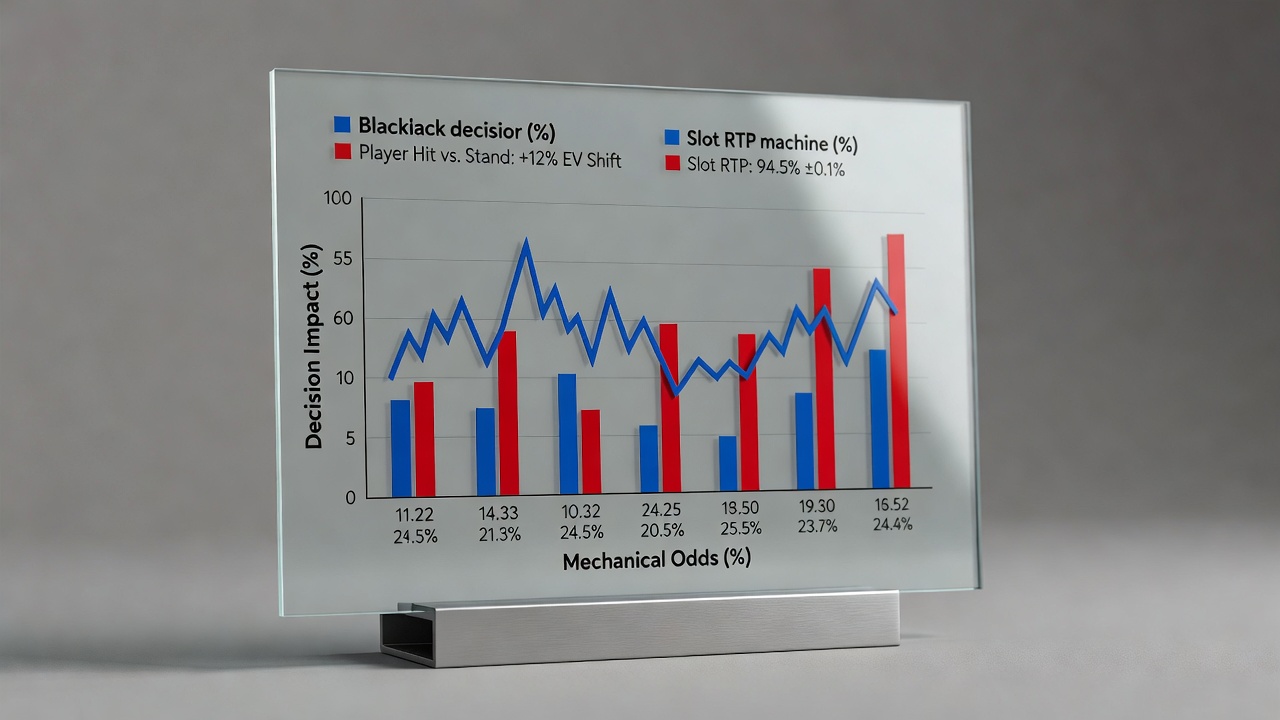
Slots employ exclusively probabilistic outcomes. Each spin produces results via random number generation. No player decision modifies probability distribution. The RTP reflects inevitable payout distribution across infinite spins.
Blackjack incorporates decision points. Player actions (hit, stand, double, split) modify expected values. RTP assumes mathematically optimal decision-making throughout.
Computational Approaches
Slot RTPs undergo empirical validation. Programmers execute thousands of simulated spins, tracking aggregate payouts against aggregate wagering. The observed ratio reflects actual RTP across sufficient sample sizes.
Blackjack RTPs derive from mathematical modeling. Analysts calculate outcome probabilities for every possible game state. They determine optimal actions maximizing expected return. They aggregate across probable hand distributions to obtain expected value percentages.
The Real-World Gap
Theoretical blackjack RTP assumes flawless strategy execution. Actual player RTP integrates strategy errors, suboptimal decisions, emotion-driven choices.
Skilled players approach theoretical RTP closely. Casual players experience significantly reduced RTP due to inferior decision-making.
Slot machines present no such variability. All players encounter identical payout distribution regardless of spin methodology.
Regulatory Implications
Licensing authorities mandate RTP disclosure. Slots report actual calculated RTP directly. Blackjack typically reports theoretical optimal-play RTP without clarifying that actual player experience differs.
A regulation requiring actual-player RTP disclosure (incorporating statistical decision errors) would reflect honesty. Casinos resist such transparency.
Player Impact on Outcomes
A hundred dollars wagered on optimally-played blackjack generates approximately fifty-cent expected loss. A hundred dollars wagered via suboptimal blackjack strategy generates two to three dollar expected loss.
Slot machines produce identical expected loss percentages regardless of button-mashing technique.
Structural Reality
This distinction emerges from game design fundamentally. Slots maximize house advantage through mathematical design alone. Blackjack relies on player errors to supplement minimal inherent advantage.
The regulatory approach accommodates this distinction by allowing theoretical RTP reporting for skill-influenced games while requiring actual RTP disclosure for pure chance games.
Casino operators prefer reporting theoretical figures for blackjack because actual figures would demonstrate how player errors inflate house advantage substantially.
Summary and Key Takeaways
The information provided above offers foundational knowledge for anyone seeking to understand this complex topic. Implementation requires careful consideration of personal circumstances, financial capacity, and long-term objectives.
Success in this area depends less on finding hidden edges and more on consistent application of sound principles. The winners in this space are those who execute flawlessly over long periods, not those chasing quick gains.
Professional participants recognize that the psychological component often determines outcome more than technical skill. Maintaining discipline during difficult periods separates successful operators from those who abandon their strategies at critical moments.
The evolution toward smarter play continues as market participants gain experience and share knowledge. What worked a decade ago may require adjustment today. Continuous learning and willingness to adapt separate enduring winners from those dependent on historical conditions.
Understanding both the mathematical and psychological dimensions provides the foundation for sustainable success. Neither dimension alone suffices for long-term profitability. The interaction between them creates the actual advantage that separates skilled operators from casual participants.
Final point: the best approach balances theoretical knowledge with practical experience. Read widely, study carefully, practice thoroughly, and maintain emotional discipline above all else.
The reality of this space involves mastering multiple dimensions simultaneously. Raw knowledge without application creates false confidence. Application without theoretical foundation creates poor decision-making under pressure.
The most successful participants integrate both. They understand the mathematical foundations deeply. They also understand human psychology and market dynamics that affect decision-making quality.
Path to mastery requires accepting that progress arrives slowly. Initial periods of learning are frustrating for many. Those who persist through frustration reach competence. Those who continue beyond competence reach mastery.
Documentation of performance helps identify weaknesses. Regular review of past decisions reveals patterns. Recognizing personal weaknesses allows targeted improvement. This self-reflection separates professional operators from dabblers.
The competitive landscape continues evolving. Standards of play improve continuously. What passes for acceptable play today will be inadequate within years. Commitment to continuous improvement becomes necessary for maintaining relevance.
Financial stability supports better decision-making. Players under financial stress make desperate decisions. Adequate bankroll eliminates the pressure that corrupts judgment. This is why bankroll management matters beyond mathematical calculation.
Personal discipline rivals skill in determining outcomes. The most talented players sometimes underperform due to poor discipline. Moderately talented players with exceptional discipline often outperform. This dynamic explains why professionals emphasize habit formation.
Long-term thinking transforms how you approach every decision. Short-term results matter less than long-term trajectory. Accepting variance becomes possible when you embrace extended timeframes. This philosophical shift often determines who persists to mastery and who quits.