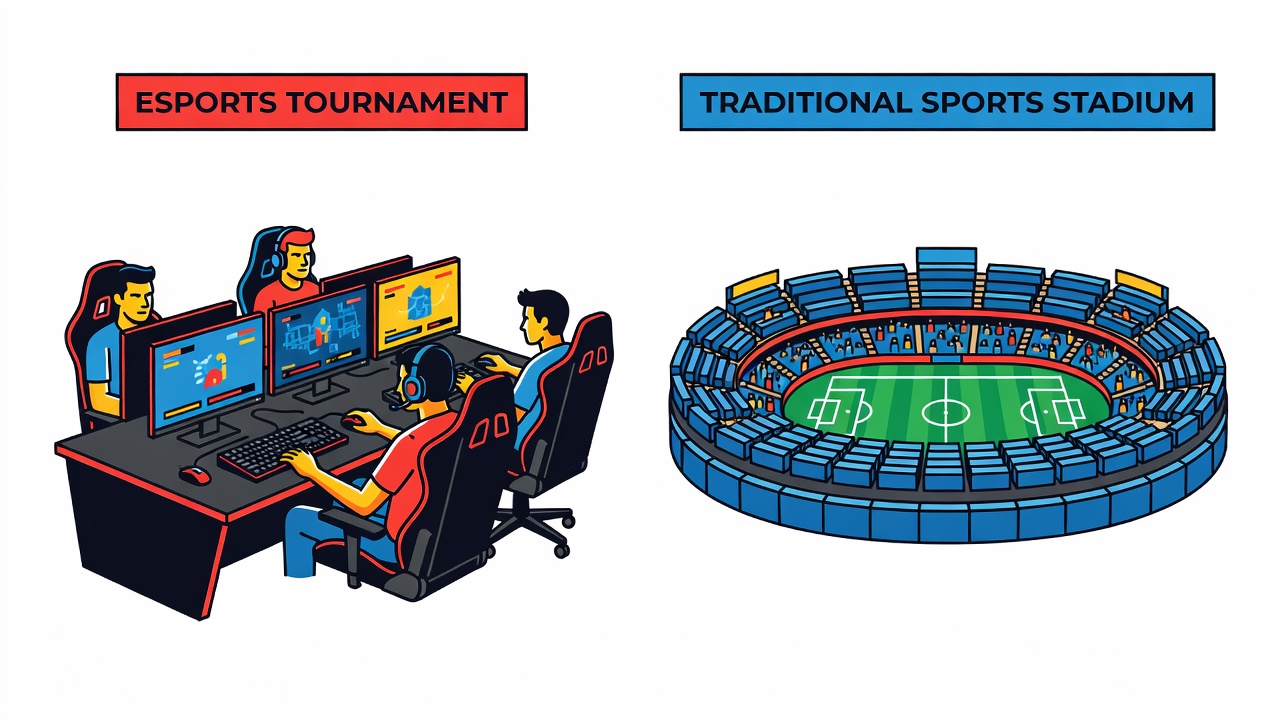
Esports betting is structurally similar to traditional sports betting but with critical differences in sample size, information quality, and market efficiency.
1. Sample Size
A traditional sport like football has 17 games per team per season. A year of betting produces 17 data points per team. An esports team might play 150 to 200 matches per year. The sample size is 10 times larger. This allows faster learning but also faster adjustment by the market.
2. Information Quality
Football betting includes decades of historical records, player injury reports, weather data, and detailed statistics. Esports betting includes recent match data (last five years mostly) and player stats that are themselves still evolving.
3. Market Efficiency
The esports betting market is younger and less efficient than the traditional sports market. Mispricing is more common. But the market is correcting faster as more capital flows in.
4. Variance in Skill
Esports competitors have lower variance in performance than traditional athletes. A chess player playing at their level will perform consistently. A football player's performance depends on weather, opponent adjustment, and injury status.
5. Betting Odds Format
Traditional sports use moneyline and point spread format. Esports uses map-based and match-based betting. The structures are different enough that bettors must relearn their approach.
6. Live Betting
Esports live betting is complex because matches last 45 to 90 minutes with rapid development. Traditional sports live betting is easier because scoring is incremental.
7. Regulatory Status
Traditional sports betting is regulated in most jurisdictions. Esports betting exists in a gray zone in many countries. This creates risk for both sportsbooks and bettors.
Summary and Key Takeaways
The information provided above offers foundational knowledge for anyone seeking to understand this complex topic. Implementation requires careful consideration of personal circumstances, financial capacity, and long-term objectives.
Success in this area depends less on finding hidden edges and more on consistent application of sound principles. The winners in this space are those who execute flawlessly over long periods, not those chasing quick gains.
Professional participants recognize that the psychological component often determines outcome more than technical skill. Maintaining discipline during difficult periods separates successful operators from those who abandon their strategies at critical moments.
The evolution toward smarter play continues as market participants gain experience and share knowledge. What worked a decade ago may require adjustment today. Continuous learning and willingness to adapt separate enduring winners from those dependent on historical conditions.
Understanding both the mathematical and psychological dimensions provides the foundation for sustainable success. Neither dimension alone suffices for long-term profitability. The interaction between them creates the actual advantage that separates skilled operators from casual participants.
Final point: the best approach balances theoretical knowledge with practical experience. Read widely, study carefully, practice thoroughly, and maintain emotional discipline above all else.
The reality of this space involves mastering multiple dimensions simultaneously. Raw knowledge without application creates false confidence. Application without theoretical foundation creates poor decision-making under pressure.
The most successful participants integrate both. They understand the mathematical foundations deeply. They also understand human psychology and market dynamics that affect decision-making quality.
Path to mastery requires accepting that progress arrives slowly. Initial periods of learning are frustrating for many. Those who persist through frustration reach competence. Those who continue beyond competence reach mastery.
Documentation of performance helps identify weaknesses. Regular review of past decisions reveals patterns. Recognizing personal weaknesses allows targeted improvement. This self-reflection separates professional operators from dabblers.
The competitive landscape continues evolving. Standards of play improve continuously. What passes for acceptable play today will be inadequate within years. Commitment to continuous improvement becomes necessary for maintaining relevance.
Financial stability supports better decision-making. Players under financial stress make desperate decisions. Adequate bankroll eliminates the pressure that corrupts judgment. This is why bankroll management matters beyond mathematical calculation.
Personal discipline rivals skill in determining outcomes. The most talented players sometimes underperform due to poor discipline. Moderately talented players with exceptional discipline often outperform. This dynamic explains why professionals emphasize habit formation.
Long-term thinking transforms how you approach every decision. Short-term results matter less than long-term trajectory. Accepting variance becomes possible when you embrace extended timeframes. This philosophical shift often determines who persists to mastery and who quits.